
Tankless Water Heaters for Reliable On-Demand Hot Water
As an Amazon Associate I earn from qualifying purchases. Some links may earn us a commission at no extra cost to you.
The best tankless water heater is the model that can meet peak hot-water demand at the home’s actual temperature rise. I compared gas and electric options for whole-home installations, smaller homes, single bathrooms, and point-of-use applications.
Top picks
Rinnai RX199iN — Best overall
The Rinnai RX199iN is my top choice for a gas-equipped home with substantial hot-water demand. Why it wins: it combines up to 11.1 GPM, a 199,000-BTU maximum input, 0.98 UEF, natural-gas or propane operation, and indoor or outdoor installation flexibility.
Rinnai lists the cabinet at 30.11 inches high, 18.5 inches wide, and 11.4 inches deep. It is also ENERGY STAR certified, recirculation-capable, and Wi-Fi-capable, although Wi-Fi accessories may be sold separately.

- One Model, Anywhere: This Rinnai tankless water heater is installable indoors or outdoors thanks to...
- Never Run Out of Hot Water with this Compact Tankless Gas Water Heater: This condensing propane and...
- Smart, Efficient Design: This water heater's modern design includes an easy-to-use interface, Quick...
Pros
- Up to 11.1 GPM for demanding households
- 0.98 UEF and ENERGY STAR certification
- Converts between natural gas and propane
- Supports indoor or outdoor installation
Cons
- Requires professional gas and venting work
- Recirculation hardware may cost extra
- Excess capacity for low-demand homes
Social proof: See reviews on Amazon.
Trade-offs / Who should skip
Skip it when the home does not have a suitable gas supply or when hot water is only needed at one sink or bathroom. Its 11.1-GPM figure is a maximum rating; usable flow will decline when incoming water is very cold or the requested outlet temperature is high.
The standard residential warranty covers the heat exchanger for 15 years or 12,000 operating hours, parts for five years, and labor for one year, subject to Rinnai’s terms.
Scores: Performance 5/5 | Usable flow 5/5 | Ease of use 4/5 | Value 4.5/5
ThermoMate ET360 36kW — Best high-output electric model
The ThermoMate ET360 is the strongest electric option in this lineup for a home that cannot use gas. Why it wins: its 36-kW output can provide up to 7.03 GPM at a relatively modest 35°F temperature rise, giving it considerably more capacity than typical point-of-use electric heaters.
The ET360 uses self-modulating heating and offers digital temperature adjustment from 80°F to 140°F. ThermoMate also identifies it as ETL certified.
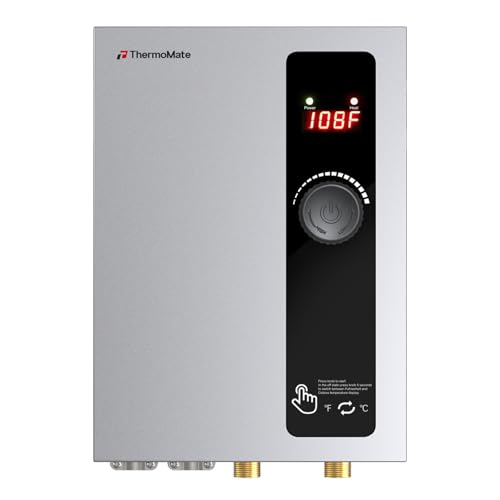
- [Instant & Endless Hot Water for Large Homes] Experience continuous hot water on demand. This 36kW...
- [Powerful Whole-House Performance] Designed for large households with high hot water demands...
- [Precise Self-Modulating Technology & 99.8% Efficiency] Advanced self-modulating technology...
Pros
- 36-kW whole-home heating capacity
- Up to 7.03 GPM at a 35°F rise
- Self-modulating power control
- ETL certification is manufacturer-verified
Cons
- Draws up to 150 amps
- Needs four dedicated circuits
- Cold groundwater sharply reduces flow
Social proof: See reviews on Amazon.
Trade-offs / Who should skip
Skip it unless an electrician confirms that the property can support four 40-amp double-pole breakers, four runs of 8-AWG copper wire, and the unit’s 150-amp maximum draw. ThermoMate recommends at least 200-amp electrical service.
Its Amazon title describes a higher maximum flow, but I used the manufacturer’s 7.03-GPM figure at a stated 35°F rise because it provides more useful sizing context. In a cold climate, several simultaneous showers can exceed its practical capacity.
Scores: Performance 4.5/5 | Usable flow 4.5/5 | Ease of use 3/5 | Value 4/5
EcoSmart ECO 27 — Best-value whole-home electric model
The EcoSmart ECO 27 is my value pick for an all-electric home with moderate demand and adequate panel capacity. Why it wins: its 27-kW self-modulating system provides a useful middle ground between small point-of-use heaters and power-hungry 36-kW models.
EcoSmart specifies a 240-volt supply, approximately 113 amps, three 40-amp double-pole breakers, three runs of 8-AWG wire, and recommended 200-amp household service. The unit measures 17 by 17 by 3.625 inches and uses 3/4-inch NPT water connections.
No products found.
Pros
- 27-kW self-modulating heating
- Compact 3.625-inch-deep enclosure
- UL 499 and ETL certification verified
- Limited lifetime warranty available
Cons
- Requires three dedicated circuits
- Not ideal for heavy cold-climate demand
- Warranty registration is required
Social proof: See reviews on Amazon.
Trade-offs / Who should skip
Skip it when the panel lacks three available double-pole breaker positions or when the home has only 100-amp or 150-amp electrical service. EcoSmart recommends a 200-amp service panel for this model.
It is better suited to warmer incoming-water temperatures or carefully managed fixture use. Two high-flow showers, a bathtub fill, or simultaneous laundry demand can overwhelm a 27-kW electric heater in colder regions.
EcoSmart lists UL 499 certification, ETL listing, a 0.3-GPM activation flow, and a limited lifetime warranty that requires registration.
Scores: Performance 4/5 | Usable flow 4/5 | Ease of use 3.5/5 | Value 4.5/5
ThermoMate ET110 11kW — Best for one bathroom
The ThermoMate ET110 is a better fit for a single bathroom or low-flow shower than for an entire house. Why it wins: its 11-kW output offers more flexibility than a sink-only heater without imposing the extreme electrical demand of a 27- or 36-kW unit.
ThermoMate lists a 46-amp maximum draw, two 30-amp double-pole breakers, two runs of 12-AWG wire, 1/2-inch NPT connections, and dimensions of 14.75 by 11.75 by 3.12 inches. The manufacturer describes it as ETL certified.
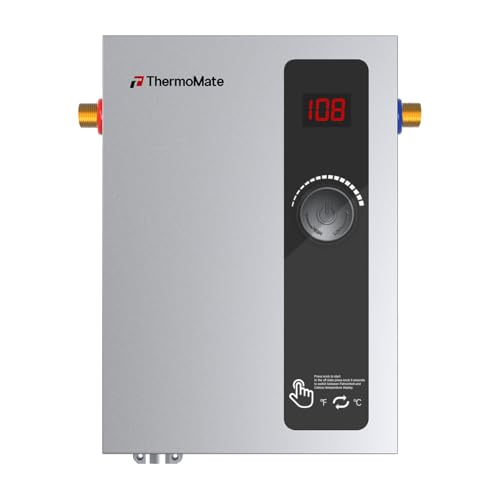
- [Instant Endless Hot Water] - Provide consistent hot water wherever and whenever you need it...
- [Leak Proof & Maintenance Free] - The first to use cast aluminum heating chamber, Heating element...
- [Save Money and Space] - Self-modulating technology auto regulating the amount of energy required to...
Pros
- Suitable for one low-flow shower
- Compact wall-mounted housing
- Self-modulating power control
- ETL certification is verified
Cons
- Not a whole-home heater
- Requires two dedicated circuits
- Limited capacity for bathtub filling
Social proof: See reviews on Amazon.
Trade-offs / Who should skip
Skip it when more than one shower or appliance may need hot water simultaneously. The exact Amazon variant specifies approximately 2.15 GPM at a 35°F rise, while ThermoMate’s general product page lists up to 2.68 GPM under less demanding conditions.
A high-flow shower or colder inlet water can push it beyond its useful range. It may respond by delivering cooler water or requiring reduced fixture flow.
Scores: Performance 3.5/5 | Usable flow 3/5 | Ease of use 4/5 | Value 4/5
Rheem RTEX-08 — Best for sinks and low-flow point-of-use installations
The Rheem RTEX-08 is my preferred compact option for a remote sink, workshop, half bathroom, or another small point-of-use installation. Why it wins: Rheem provides clearer warranty and certification documentation than many competing compact heaters.
Rheem’s current specifications list a 0.8-to-1.4-GPM operating range, UEF up to 0.96, and digital temperature adjustment from 80°F to 140°F. The model uses replaceable copper immersion heating elements and does not require combustion venting.
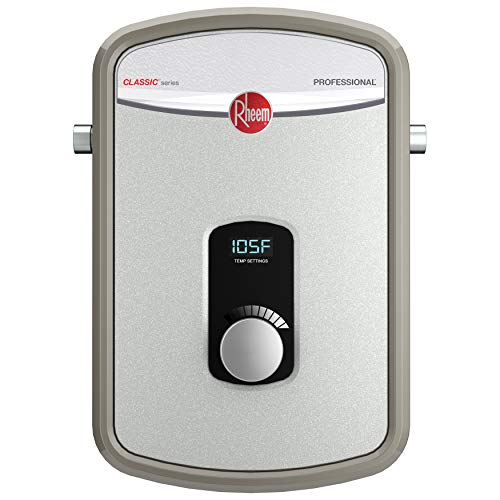
- Get the performance you expect. Choose the right size water heater for your home and verify...
- 8kW model provides up to 1.95 GPM
- Multiple fixture applicatons

Pros
- Good match for a remote sink
- UEF up to 0.96
- Replaceable copper heating elements
- ETL and UL marks are manufacturer-verified
Cons
- Too small for most showers
- Limited to one low-flow fixture
- Only one year of parts coverage
Social proof: See reviews on Amazon.
Trade-offs / Who should skip
Skip it as a whole-home replacement. Although some Rheem materials mention higher theoretical flow, the current model specifications list a maximum of 1.4 GPM, so I used that conservative figure for scoring.
A typical shower can demand around 1.5–2 GPM before accounting for temperature rise, leaving little or no reserve capacity. This model makes more sense when it is installed close to a sink and serves one fixture at a time.
Rheem covers the heating chamber for five years and parts for one year.
Scores: Performance 3/5 | Usable flow 2.5/5 | Ease of use 4.5/5 | Value 4/5
Quick compare
- Rinnai RX199iN: Best overall for large gas-equipped homes
- ThermoMate ET360: Best high-output electric option
- EcoSmart ECO 27: Best-value whole-home electric model
- ThermoMate ET110: Best for one bathroom or low-flow shower
- Rheem RTEX-08: Best for sinks and point-of-use installations
As an Amazon Associate, I earn from qualifying purchases.